The next level of a High Performance Team
Prof. Jan van Zwieten RI,RA,RO
1. Introduction
During the second half of the twentieth century, many companies have started working with the concept of “High Performance Team”. What is new in this manner of thinking, is that there is much more attention to the team members, their mindset and their behaviour. We started to realise that a team consists of individual persons and that motivation, interaction and communication are essential for performance. In 1950, the Tavistock Institute (U.K.) had already described the characteristics of a high performing team, yet it would still take many years before larger companies welcomed the concept with open arms. This acceptance (mostly in the United States) grew simultaneously with the results of successful implementations into a select group of big organisations. However, as is often the case, success may become a pitfall. Many advisors developed variants that did not always lead to better results. The concept’s popularity thereupon decreased, but the general way of thinking about the successful functioning of teams remained.
At the start of this century, we thus saw a revival of this concept, albeit with a few contemporary additions. In this article, we will refer to it as the strive for a “dream team”. Most changes to the ‘old’
concept were caused by external factors. The development in company life (with a culture of short-term results and a number of large fraud cases) gave input for extra attention to the ethical awareness. Besides, we now also take sustainability (climate) and social responsibility and the quality of life into account. It should therefore come as no surprise that we have seen this arise in the manner of thinking about dream teams as well.
The basic definition of a team that comes forward in all publications is simple:
‘Two or more individuals that cooperate in order to reach a common goal.”
However, the basic thought of how High Performance Team expresses itself might be best clarified by Dutch philosopher (and football player) Johan Cruyff:
If you choose the best player for every position, you would not have a strong team,
but one that falls apart like loose sand.
Johan Cruyff (football player/trainer)
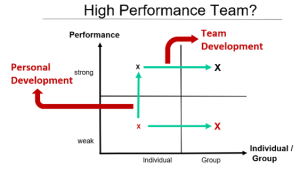 When thinking about teams in the elementary form, we thus find a clear dichotomy:
The core of this thought is that it is not only about making the individual members of the team stronger, but that there is also a dimension to make them optimally work together. This collaboration starts with divisions of tasks and placing the right person in the right place, yet evidently goes much further. How do we make sure that they actually work together to achieve the goals?
The interpretation of the characteristics and thus the formula for success as a team is always different for all authors. In this series of articles, we follow the structure of the Teamstar model. This model includes all the characteristics that have emerged in major, serious investigations since 1950, and in addition includes thinking in continuity and sustainability. Out of this we can construct the following structure:
- Unifying separate individuals into a single entity; alignment and involvement
- The optimal level of functioning as a dream team; efficiency and effectivity
- Ensuring a sustainable dream team is created; development and vitality
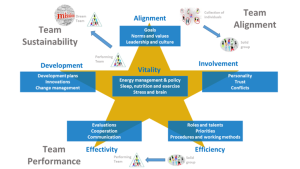
Teamstar – van Zwieten and Smit 2019
This is the first out of four articles about teams. This article discusses the basic structure of thinking about teams. What is a team? In what way has thinking about teams developed over time? What are the characteristics of a dream team? This all comes together in the three aforementioned main elements. These key elements are the core for successful working in teams. These are then worked out individually within the following articles:
Article 2; Alignment – from individuals to a unit (alignment and involvement)
Article 3; Performance – the unit as a performing team (efficiency and effectivity)
Article 4; Sustainability – sustainability of man and organisation (development and vitality)
2. Why are people together and when can one speak of a team?
2.1 Social cohesion
There are many different reasons why people are together, and with that comes a variety of forms of cooperation. This is important to understand, because it also determines what leads to optimal collaboration. What interests do people have? What moves them? Why do they do what they do? And in this context, when are we talking about a team? To answer these questions, a number of elements are decisive:
- The degree of connectedness. There is a significant difference in whether people are together only once for example to watch a disaster, artist or event, whether people are connected based on a common identity (religion, culture), or whether they have to perform a common task together (organisation, sports team).
- The duration of cooperation. Often groups are connected for a certain period of time. This may be for one-time activities, a project, time-related or permanent.
- The frequency of being together.
Basically, the subdivision of the partnerships is as follows:
- Crowd (or mob); unrelated individuals who are together for a temporary goal.
- Alliance; a partnership of groups who (often for a limited amount of time) want to solve a particular problem.
- Group; a number of people with a common identity.
- Team; a group that regularly works together on related tasks to achieve a common goal or goals.
A crowd is a number of stand-alone individuals who are together for a specific (usually fairly general) purpose. We can actually split this in two categories; crowd and mob. A crowd comes together for something specific (a fire or a VIP), but what is missing is the common purpose, the feeling of belonging, there is no real bond between the people and they also do not pursue a common goal in which they need each other. It is therefore known from psychology that people tend to blend in with the masses and do not take responsibility in such a situation. In the event of an accident involving many bystanders, only with great exception will one take initiative. In the case of a mob, there is a certain form of structure, there is a common goal for which people want to work hard, for example the call of the masses for the resignation of a president. Since it is about connecting many people on one subject, without a deeper basis of identity, it is in almost all cases focussed on one aspect, and thus ephemeral and variable.
An alliance is a partnership in which a number of groups unite to pursue an important goal. In doing so, they often give up part of their autonomy. However, the strength of this binding force is proportional to the importance attached to it. In the fight against Islamic State (IS/Daesh), an alliance of all militarily active parties in the region emerged. The weaker IS became, the looser the alliance would return to action. The United Nations is an alliance that has a much longer life. But here too we see that the common interest does not always come first. This phenomenon is seen in many areas, such as politics, businesses or even children at schools.
A group has its own identity, one may speak of social cohesion. This provides a more structural basis for the sense belonging. This is expressed in a common goal (at least reflecting the connection to this identity) and the values and standards that fit the identity of the group. We can think of nations, religious groups, diversity groups, economic partnerships, political connectedness. People often belong to different groups (faith, country, gender, party, etc.) and therefore have different elements in their identity. People can belong to the same group (country), but because of belonging to other groups they still can be in conflict. Consider the persecution of minorities in a country.
Social psychologist Muzafer Sherif defined a social unit (group) as a number of individuals that have common ground on the following aspects:
- Common motives and goals;
- An agreed upon division of tasks, i.e. roles;
- Established status (social rang, dominance), relationships
- Accepted norms and values relating to relevant problems for the group;
- Development of affirmed sanctions (reward and punishment) if and when norms are strived for or violated.
In a team, people work together based on a division of tasks to achieve certain goals. It is clearly defined what participation in the team entails and in what manner individual roles are divided. However, the core is that even when everyone makes their own contribution, the team as a whole is responsible for the result. Teams are therefore formed if the tasks are too extensive and/or too complex for an individual. Different qualities and competencies are often necessary to achieve certain goals. For example, a football team not only consists of forwards, but of defenders, midfielders and a goalkeeper as well. In addition, we look at right-footed or left-footed players and their captain, a coach, a caretaker, etcetera. It is in no way any different in business.
Talents win games, Teams win championships
Michael Jordan (Basketball player)
Depending on the objective, the tasks are determined. These are thereafter assigned to team members. Whenever a team lacks expertise, it will look for this outside the team.
| Crowd | Alliance | Group | Team |
| Temporary goal | Specific targeted goal | Common binding through feelings and interests | Team goal-setting |
| No identity | No identity | Common identity and characteristics | Task descriptions focused on goal |
| Little binding | Full own autonomy | Affirmed norms and values | Accepted norms and values |
| Temporary, unpredictable | Dependent on duration and importance of goal | Long-term | Dependent on task |
| Established status and relationships | Clear tasks and roles | ||
| Sanction/reward for norms and values | Individual and team results | ||
| Limited size (direct contact between members) |
Characteristic for a team is therefore mainly the specific objective and the clear division of tasks. It is important that the individual results are clearly defined and people bear responsibility for them as well. A team always consists of a limited number of people who can communicate with each other effectively to perform the tasks together. Research by MIT (Prof Alex “Sandy” Pentland) has shown a direct link between the degree of direct contact and the results of a team. Direct contact (instead of email and remote steering) provides energy, creativity and common will in order to reach certain goals. More contact resulted in significantly better performance. But the contacts must always be short and effective. Based on this, the optimal team size is maintained at 7 to 10 people.
If you cannot feed your team with two pizzas, it is too large!
Jeffrey P. Bezos (CEO of Amazon)
The underlying thought when discussing a team, is that the cooperation leads to synergy, i.e. the output of the team is higher than the sum of the performances of individual team members.
3. Development of general visions regarding team
Our way of thinking about teams origins in the 1950s. This is a logical looking at the development of society over the years. Between 1750 and 1950 (Industrial Revolution), we see companies are managed primarily on operations. Logistics, planning and structure must occupy centre-stage. The principles of Frenchman Henri Fayol and the American Frederick Taylor (described and put into practice between 1860 and 1920) are regarded as a model for the aforementioned way of management. This is described as scientific management or knowledge management. People (employees) are not important as human beings and treated as a machine.
High Performance Teams
Around 1950 managers start realizing that teams are made up of people. The first studies are carried out to see how we can bring these people to reach optimal performance. In particular, the publications of the “Tavistock Institute” in the 1950s gave a good overall view of the new way of thinking, people are key. Their concept of “High Performance Teams” (HPT) was quickly gaining popularity.
The concept of HPT is basically quite simple; a solid team that continuously achieves good results because of cooperation and innovation. The focus on the results ensures that they as a unity manage to solve all problems.
Follow-up studies such as those of Gully (from 1995 to 2002) and Baker (2005) gave a new boost with additional evidence that the following elements lead to more effective team performance:
- A clear goal in which involved individuals actually believe;
- The required knowledge, ability and skills in order to realise the goals;
- Flexibility and capacity to adapt (self confidence in one’s own abilities)
- All team members are individually prepared to do what it takes in order to reach the goals and do take their responsibility;
- Participants give up part of their autonomy and tune their actions in accordance with Hereby, we find good mutual relationships;
- Conflicts and feedback are used constructively and do not affect the atmosphere.
During later phases, a few elements were added and/or specified:
- A democratic leadership style (participative leadership), in which team members are feeling involved;
- Effective decision-making (both rational and intuitive, depending on the decision);
- Open and clear communication;
- Open to look for complementarity. Usage of all available knowledge and abilities in the team;
- Mutual trust; trust in the team and one’s co-workers;
- Clear roles, task descriptions and responsibilities that are acknowledged by all team members;
- Culture characterised by openness, transparency, positivity and future-oriented; Everything is focussed on the successful execution of the goal.
4. Team development
4.1 Phases of Tuckman
The basis of thinking about the phases a team experiences has been laid by Prof Bruce Tuckman. In 1965, he described the phases of group development. He concluded there are four phases; forming – storming – norming – performing. In 1977 he added adjournment (farewell). Schematically, this can be displayed as follows:
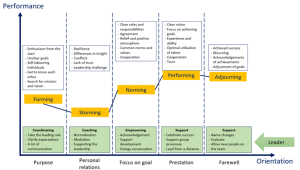
Tuckman 1965-1977
Tuckman’s studies showed that about 50% of the teams skipped phase 2 (storming) and went directly from phase 1 to phase 3. Teams that did go through the storming phase risked getting stuck inside it or falling back into it because the relations were structurally disturbed.
Coming together is a beginning, staying together is progress, cooperating is success.
Henry Ford (founder Ford car manufacturing)
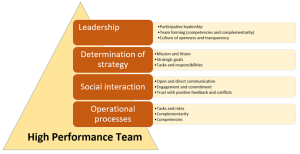
In Tuckman’s phases, we see that the processes of a High Performance Team are central;
- Determination of strategy; the tasks of the team are derived from the goals that are to be achieved. The basis is therefore a clear determination of the mission, vision and the strategic objectives to be deduced from it. In this development, the way in which these goals are determined moves from “Tell” to “Ask”. The further the team gets, the more the objectives are determined in consultation and the more the leader is distanced from.
- Social interaction; How do teams cope with differences of opinion and the frictions or even conflicts that arise from this. In later phases the way members are motivated and want to cooperate.
- Operational processes; In order to achieve the goals, it is important to optimise the operational processes. The start therefore mainly concerns the coordination of activities. The further the team develops, the more it shifts to coaching and supporting the team members and their interaction. Ultimately, monitoring progress and evaluating the deployment of people and resources become part of this category.
4.2 Personality analysis – DISC and Belbin
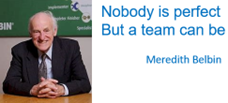
More and more, the emphasis of thinking about teams has
Shifted to partnership. It is therefore not surprising that there is much attention paid to personality traits of team members. The starting point is often that one searches for characteristics that match the primary task and purpose of the team. Later, however, people became aware that there must be sufficient diversity. The complementarity ensures that all the necessary competencies are present when the team ultimately has to execute the tasks. An overly one-sided composition of the team presents problems in performing certain tasks and possible blind spots that can prevent the team from reaching its goals or even break up the team. As an example; the management team of a construction company consisted of all structured rational thinkers who had made their mark in carrying out complex construction projects. Eventually, they were unsuccessful on the market, because of a lack of creativity and flexibility. In an ever changing market, they did not move fast enough and the strategy was not focused on future challenges.
Initially, DISC was often used as one of the first methodologies in the field of behavioural determination. Then, in 1981, Belbin published his book “Management Teams”. As DISC is more focused on individuals, Belbin developed an assessment on the same bases that mapped 9 team roles. Belbin worked for 7 years with specialists from a completely different background. They were hence able to make a statement about a team’s performance with reasonable certainty.
Belbin has derived some important conclusions:
- Having too many comparable profiles begets a one-sided manner of team functioning;
- Similar profiles are inclined to compete against one another, something that results in unproductive conflicts;
- People must be awarded a role that fits their natural preferences;
- Almost everybody has two preferences. Using them, it becomes easy to cover all tasks;
- Team members must learn to think complementary instead of divergent (which, in their opinion, implies dysfunctional behaviour).
Seeing personality traits as part of specific competencies has given it an extra dimension. This complements the aforementioned studies by the Tavistock Institute and Tuckman.
4.3 Lencioni

Although Patrick Lencioni’s most important work was published in 2002 (“The Five Dysfunctions of a Team”), it is still undoubtedly popular to this day. Notwithstanding that the book is negatively formulated (dysfunctions), one can also suggest it contains the ingredients for successful functioning. Unlike a number of the aforementioned authors, the methodology is not a result of structural research but is based on a lot of experience in consultancy.
Lencioni describes the five frustrations as a cohesive whole. This also indicates that the dysfunction on one of the five axiomatically leads to lower performance. He displays this in the following model:
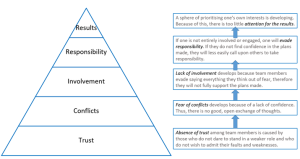
Patrick Lencioni – 2002
It is striking that there are no specific new elements in his vision. What makes this point of view special, is the choice of the most important characteristics of a successful team and the coherence of the elements. The assessments Lencioni has developed for measuring these elements have contributed a great deal to the popularity of his vision.
5. Teamstar
The Teamstar model consists of three main elements:
- Bringing unrelated individuals to a solid group (alignment); alignment and involvement
- The optimal functioning of a performing team; efficiency and effectivity
- Setting the basis for a sustainable dream team; development and vitality
Here, especially thinking about the future in development and vitality is new. The current requirements call for longer-term thinking. Here, the individual remains central. At a time when it is difficult to attain (skilful) people, attention should be paid to retaining the people (retainment) and maintaining the performance of the employees.
5.1 Alignment
How do we get some loose individuals to act as a team? In sports, we see this in its most extreme form because the results are immediately visible. How is it possible that a team that did not perform well under one coach suddenly wins everything when the coach is changed? Even with the same players! And this is no different in business, but the effect is often only visible on the slightly longer term. So, it is not the level of the team members. It is about the mindset in which participants work together to achieve their goals. We distinguish two main themes; Alignment and Involvement.
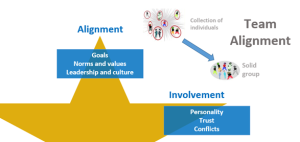
On the one hand, the goal must be clear and appealing. If we do not know where we are going, we will never get there. But it also is demanding good leadership. Does the leader know how to inspire and motivate people to go for these goals? Because we are speaking of a team, this goes beyond just the interests and motivation of the individual. It is precisely the willingness to subord individual interests to the team interest that requires a culture of trust based on conformity of common values and norms. Understanding the personality of the team members helps to inspire and motivate them. If the culture is such that open feedback can be given and conflicts have a constructive character in the cooperation, the team will be able to achieve synergy.
5.2 Performance
To perform well the team must function effective and efficient;
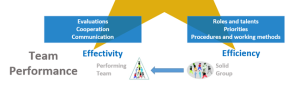
In order to function efficiently, all the necessary competencies must be present. It is therefore imperative the team have a clear understanding of the tasks, procedures and practices in order to know which expertise is required. Contrastingly, as Belbin has shown, it is not just about the competencies related to the primarily processes. It is also necessary to analyse on the basis of the personalities whether the team has what is needed given the task on the long run. Diversity and balance are often the most important factors. Good insight into the procedures and working methods also ensures the efficient distribution of tasks. A well-known phenomenon is the loss of focus on the things that are most important. Therefore, thinking and working according to priorities significantly improves results.
When one discusses the role of a team member, there are a number of extra requirements. Effectiveness is therefore mainly about the interaction between the group members. How do we work together? In what way do we communicate? As Pentland has researched, active but efficient ‘live’ communication is essential for performance. A system of continuous evaluation, feedback and communication regarding this ensures a lasting growth.
5.3 Sustainability
After a long period in which companies only focussed on short-term (financial) results, there has been a change in thinking patterns. The first reason was the publication of major fraud cases and later the banking crisis. This has led to a call for ethical awareness and the control of excesses in rewards.
In addition, the mentality about quality of life is also different. The increasing number of people with burnouts, structural stress, sleep problems and poor health (obesity, diabetes), alongside the increasing ageing of people accompanied by their necessary need for care, has made people realise that it is not only about the sustainability of companies but also about the sustainability of the people in them.
A third factor is the climate debate and the call for corporate social responsibility. Under pressure of the younger generation and the studies on problems in the (near) future that can no longer be denied, thinking in sustainability and social accountability for companies has become a reality.
The final phase therefore forces a company to implement innovations and changes to meet the requirements of our time. This implies adjusting the way of doing business to meet the demands of sustainability and climate, as well as better handling of the people in the organisation.
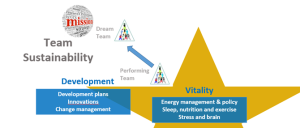
Working with Personal Development Plans (PDP) and Team Development Plans (TDP) is not new, but has been given a different interpretation. It is not primarily about the direct functioning and competences that are discussed periodically, but is rather a continuous process of monitoring the objectives of growth, development and vitality.
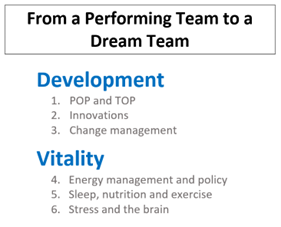
Speaking of vitality, the organisation is also expected to develop a structural policy in this area. While many companies have done this many years ago on safety, it is now also the new standard in terms of vitality. At its core is that an employee is stimulated and motivated to let vitality guide the entire lifestyle, the work-life balance. Elements that are considered in the block of vitality are therefore in addition to the policy general energy management, physical elements such as sleep, nutrition and movement and also stress and the brain performance.
5.4 Essence of Teamstar
The three main elements of Teamstar cannot be seen as phases that a team goes through, like with Tuckman’s development phases. It is a vision to continuously monitor and evaluate a team in order to continue the growth.
You must change in order to improve; you must change a lot in order to become perfect.
Winston Churchill (statesman/journalist)
About the author